
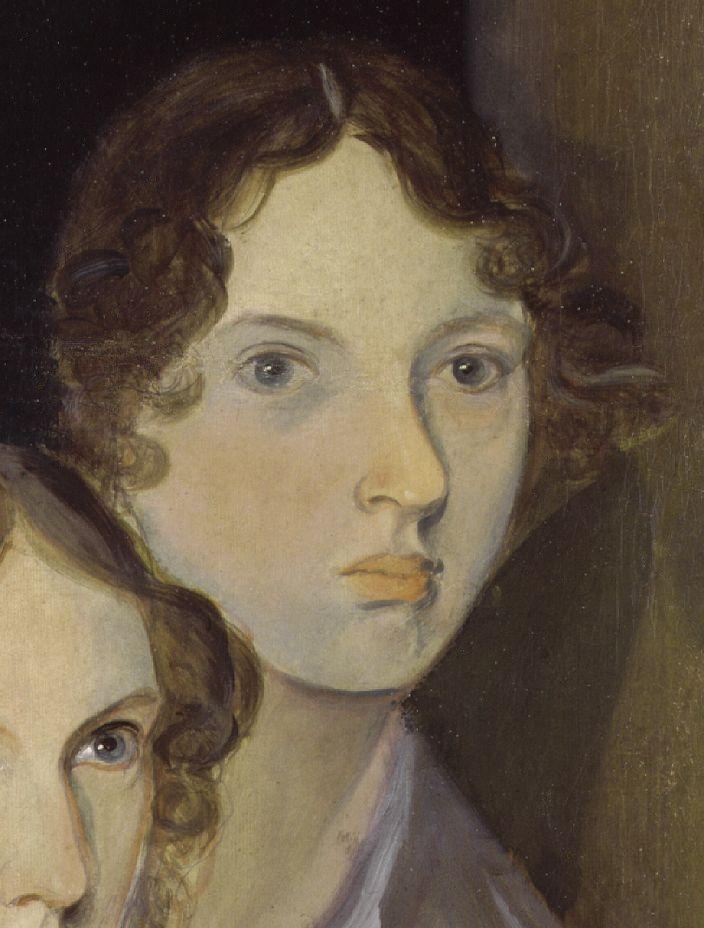
Emily Brontë, Rumi, and the Authentic Self
~ Daniel Thomas Dyer
Either appear as you are or be as you appear.
[Rumi, from ‘The Seven Counsels of Rumi’, trans. by Kabir and Camille Helminski]
Emily Brontë was born in 1818 and lived most of her life in Haworth, West Yorkshire. Like another great poet from the previous generation, John Keats, she died of tuberculosis at the young age of thirty. She is, of course, most famous as the author of Wuthering Heights—her one and only novel published two years before she died. For those who haven’t read it, it is centred on the destructive passion between Cathy and Heathcliff, and today it’s celebrated as a classic of English literature.
I read Wuthering Heights for the first time two years ago, having only been familiar with Emily Brontë’s poetry before then. I have to admit the stark cruelty and selfishness of the characters surprized me—a common reaction. The characters are as merciless as the rain that sometimes pours down on the Yorkshire moors. Oddly enough, there is relatively little description of the moors in the novel; it all gets transposed into the elemental passions of the characters, who often seem to be embodiments of the moors themselves—at their most unforgiving. That’s one way of reading the novel. Cathy and Heathcliff are selfish and cruel in a larger than life way, and these traits extend to many of the other characters too—in how they bicker, insult, and physically abuse each other. Cathy wants to possess Heathcliff and yet she’s sharply conscious of his social inferiority. Heathcliff is a dark-skinned orphan adopted into her family by her father: perhaps both racial and social bigotry prevent her from seeing him as a possible husband and social equal (as well as the unspoken possibility that he may in fact be her half-brother—her father’s unacknowledged illegitimate son). Yet we feel little sympathy for Heathcliff. In today’s terms we might use the term ‘toxic masculinity’ when describing him. He’s an abusive and dangerous bully, prepared to destroy anyone who gets between him and the object of his passion: Cathy.
Critics at the time were generally perplexed at what they called the ‘savagery’ of the characters. Many were moved to disapproval or moral disgust with the author for presenting such scenes. This review was discovered in Emily Brontë’s writing desk after her death, and is from The Atlas:
Wuthering Heights is a strange, inartistic story. There are evidences in every chapter of a sort of rugged power—an unconscious strength—which the possessor seems never to think of turning to the best advantage. The general effect is inexpressibly painful. We know nothing in the whole range of our fictitious literature which presents such shocking pictures of the worst forms of humanity.
Graham’s Lady Magazine wrote:
How a human being could have attempted such a book as the present without committing suicide before he had finished a dozen chapters, is a mystery. It is a compound of vulgar depravity and unnatural horrors…
I should add here by way of explanation that Emily Brontë wrote under a male pseudonym, so reviewers assumed she was a man. We can assume their outrage would have been even greater if they knew she was a woman. And finally from The Literary World…
In the whole story not a single trait of character is elicited which can command our admiration, not one of the fine feelings of our nature seems to have formed a part in the composition of its principal actors. In spite of the disgusting coarseness of much of the dialogue, and the improbabilities of much of the plot, we are spellbound.
So though many contemporary critics were appalled and dismissive, there were some who were ‘spellbound’ by something unsettling, strange, and original in the novel. And that fascination grew throughout the rest of the Victorian era, until by the early twentieth century Wuthering Heights was considered one of the great English novels and perhaps the best novel written by one of the Brontë sisters. I’ve long admired—in her poetry—how well Emily Brontë could describe noble, virtuous characters and elevated, mystical states of consciousness, so I was left scratching my head at why she avoided these so assiduously in Wuthering Heights. What was she trying to convey and why does this darkness in the novel feel so pertinent right now?
In reflecting on this, I reflected on what we know of her character. On the one hand, she was acknowledged by her contemporaries to be fiercely intelligent, imaginative, and strong willed. On the other, she seems to have been intensely shy and quiet, actively avoiding social encounters, preferring to roam alone on the moors or perhaps in the company of close family members. I sense in her a strong aversion to small talk, polite society, and to anything petty, pretentious, or inauthentic. I sense in her also an anger—anger at the stifling Victorian society which obliged people to wear such masks—saying what they don’t really think and appearing contrary to what they really are.
A recent film called Emily (2022) seems to me to capture her character pretty well— I recommend it. On the downside, it plays a little loose with the facts and doesn’t really get across her poetic genius. The film speculates that she may have had a romantic relationship with a young curate. There’s no known evidence of her ever having had a romantic attachment, and the contemporary accounts of young men who met her suggest they found her quietness unsettling. Whether or not she ever found one to whom she could give her affection, it’s likely she found most of them insipid.
The conclusion I have come to is that in Wuthering Heights she wanted to show what really lies underneath all that social posturing for which she had so little time. What if there were a small community on the Yorkshire moors where ordinary civility and social decorum were ignored and people spoke exactly what they thought no matter how ugly or offensive, and where people’s passions and emotions were as exposed and as naked as the moors themselves? Nothing hidden and no pretence. In other words, where people appeared on the outside exactly as they are on the inside.
She didn’t want to paint a pretty picture, and she startled her audience by bringing Gothic extremes of cruel passion into the familiar setting of Victorian society, albeit on the remote Yorkshire moors. She wanted to rub society’s face in something unpleasant—and to some extent perhaps her own. What she portrays through Cathy and Heathcliff is what we in the Sufi tradition would call the ‘compulsive self’—the lowest level of human consciousness, there being seven ascending levels. We’re all caught in this very low level sometimes; perhaps some of us, like Cathy and Heathcliff, spend our lives there. It’s characterized by blame, resentment, envy, greed, possessiveness; a lack of self-awareness and egoic absorption in our own desires, whims, and fears. At this level, our hearts are shut off from the light that lends humility, generosity, self-awareness, etc. Sufis call it the ‘compulsive self’, but it’s as if we have multiple selves at this level because we have no stable centre; chaotic, incoherent, and fragmented, we are tyrannised by our own changing passions, pulled this way and that. This is the state of Cathy and Heathcliff, who swing violently between love and hatred for one another, destroying their own lives and the lives of those around them in the process. And possibly it is often the state of our own egos, underneath the serene masks we like to present to the world. Like crazed addicts, our egos feed on the agonising dramas we create for ourselves, don’t they? But usually in the dark, under the mask.
It’s captured well in Kate Bush’s song ‘Wuthering Heights’, which is based on the novel. With it’s wild, swooping melody, sudden shifts, and strange repetitions, it really gets across the sense of an unbalanced ego completely wrapped up in the drama of its own story. Yet it is also graceful and moving and tugs at the heart. And this seems fitting, because the passion between Cathy and Heathcliff, at its core, has something pure and graceful in it that might even be called ‘love’. It’s just that they don’t know how to express it. They don’t have the maturity, balance, or inner coherence to channel it in a healthy way. It’s the human tragedy—in our own lives too perhaps. We are our own worst enemies.
Of course, one of the essential steps on the spiritual path is to look into that abyss within ourselves and acknowledge the countless subtle ways we are tyrannised by our own egos—perhaps not on the scale of Cathy and Heathcliff—but tyrannised nonetheless. We might prefer to keep the mask on, or look the other way. It takes courage to look into that darkness and turmoil. But all the great mystics (of every religion) encourage us to do so, as a first step towards healing. Rumi advises:
Life’s waters flow from darkness.
Search the darkness, don’t run from it.[Kulliyat-e Shams: 2232, from Love Is a Stranger, trans. Kabir Helminski]
But a book like Wuthering Heights invites us to not only to look into the darkness behind our own mask, but the darkness in society at large too—and I think this is why it feels so pertinent to our times right now. Behind the official narrative spun by our mainstream media, behind the façade of civility and democracy spun by our political leaders, what forces are really in control? More and more people are realising that the authorities in which we have placed our trust have long ago been captured by heartless corporate interests—Big Finance, Big Pharma, Big Tech, Big Weapons. While outwardly they assure us they act in our best interests, in reality they are serving quite another agenda. They are not what they appear.
This can be deeply unsettling to contemplate—often we’d rather look the other way and live in denial. Perhaps we cannot stand the thought that we may have been so thoroughly duped and manipulated all our lives. We also like to think that most people are basically decent—like us perhaps—that the people in control couldn’t be so morally bankrupt and inauthentic. But I would argue that we are often deceived by our own limited frame of reference, that the spectrum of human character is far wider than we commonly think—there are far greater extremes of dark and light than we imagine, from the sociopath to the saint. Wuthering Heights focuses relentlessly on that darker end of the spectrum. The peaceful domesticity we might expect to find in Victorian households on the Yorkshire moors is violently shattered by the casual malevolence of the characters and seems to goad us: ‘Come into this exposed and bleak world and see how bad human nature can be—maybe it’s this bad within you yourself, despite your civilized posturing.’
Whilst there is precious little light in Wuthering Heights, a kind of peace and healing does finally arrive over time—not in Cathy and Heathcliff’s generation but in the generation that follows. It might make us reflect that perhaps we, too, must sometimes fight the darkness with the realisation that the light may not dawn in our own generation. Either way, Wuthering Heights is an original and unsettling novel that gets us pondering the dark undercurrents running through our lives, both inside and outside.
The novel is not without its flaws. The immorality of its characters probably isn’t so novel and startling as it was when written, and the storms of self-absorbed passion it portrays have been much parodied, lovingly and otherwise. Many modern readers find it hard-going. The narrative device is also applied half-heartedly: two characters within the novel act as narrators, yet Brontë seems to slip out of character most of the time to tell the story better in her own voice.
I would argue that it’s actually in her poetry that Emily Brontë really shines. There, too, we find she often describes bleak circumstances: in one poem she might be describing a sense of loss, grief, or loneliness; in another she might be speaking from the perspective of one of the characters in the fantasy world, Gondal, that she created with her sister Ann: a character locked in a dungeon perhaps, or perhaps on their deathbed. But in the poetry we often find much more noble and selfless sentiments than those expressed by Cathy or Heathcliff, and we find also that courage, imagination, humility, and a sense of the sacred are usually on hand to inspire some hope. Here Brontë portrays the other end of the spectrum too—heroic, saintly characters, though often doomed, take a stand, their authenticity setting them at odds with the masters of the world whose ‘aspect is bland and kind / But hard as hardest flint, the soul that lurks behind’ (‘The Prisoner [A Fragment]’). The high fantasy world she created with her sister Ann is a far cry from the post-modern ‘grimdark’ genre so popular today, where all characters exist in a grey, morally compromised middle ground, where no one is saintly just as no one is evil, and God is an irrelevance.
Crucially, for Emily Brontë, the noble virtues are awakened by a very real and intimate experience of the Divine Presence—of a God within and all around us. This is expressed beautifully in poems like ‘The Prisoner (A Fragment)’, ‘A Day Dream’, ‘Anticipation’, ‘Stars’, and ‘No coward soul is mine’. The last mentioned—one the greatest spiritual poems in the English language—is worth presenting in full:
No coward soul is mine
No trembler in the world’s storm-troubled sphere
I see Heaven’s glories shine
And Faith shines equal arming me from FearO God within my breast
Almighty ever-present Deity
Life, that in me hast rest,
As I Undying Life, have power in TheeVain are the thousand creeds
That move men’s hearts, unutterably vain,
Worthless as withered weeds
Or idlest froth amid the boundless mainTo waken doubt in one
Holding so fast by thy infinity,
So surely anchored on
The steadfast rock of Immortality.With wide-embracing love
Thy spirit animates eternal years
Pervades and broods above,
Changes, sustains, dissolves, creates and rearsThough earth and moon were gone
And suns and universes ceased to be
And Thou wert left alone
Every Existence would exist in theeThere is not room for Death
Nor atom that his might could render void
Since thou art Being and Breath
And what thou art may never be destroyed.
Perhaps we can imagine Emily Brontë ecstatically chanting these lines in the midst of a thunderstorm on the moors. It’s the kind of uplifting call to arms we need right now. It expresses a fierce commitment to avoid dogma and champion freedom of thought and speech (how much censorship we are experiencing now!), seemingly aware that so often the original revelation received by a prophet is distorted by a clerical or political class in the centuries that follow, its spirit lost, until it becomes a rigid rule book of dos and don’ts—at its worst, a weapon used cynically to control and silence people.
Then there is her perception of a God who dwells within every atom of creation—not remote nor separate, but actively alive and present within and around us—especially in nature. Some critics have mistakenly labelled her perspective as ‘pantheism’. But pantheism is the idea that the universe equals God. This is not Brontë’s perspective, as the penultimate stanza makes clear. For Brontë, although God is immanent within the universe, God also far transcends it in unimaginable glory. This is in line with the understanding of the great mystics of numerous religions—whether a Christian mystic like Meister Eckhart, a Muslim mystic like Rumi, or a Hindu mystic like Shankara. They assert the same thing: that the one God is both immanent and yet transcendent at the same time. Rather than pantheism, this has sometimes been called theomonism: a type of monotheism that asserts that ultimately only God exists—we are all expressions of God, and our universe is a beautiful, passing smile on the Face of God.
And the third line of the final stanza, ‘Since thou art Being and Breath’, hints at a profound awareness. Those simple words align Brontë with the teaching found in, say, Hinduism, Buddhism, or Sufi Islam: the literal importance of the breath as a gateway to experiencing not only our own being but the Being of God. It’s an important aspect of meditation, and whilst meditation may have been unfamiliar to most people in Victorian England—except perhaps among the monastic orders and the Quakers—I suspect that Emily Brontë, alone in the silence and solitude of the moors, was often engaged in some form of it. Perhaps it helped her discover an authentic self beyond the posturing expected by society, as well as the one authentic Self that ‘pervades’ us all. That she was intuiting these truths and making these connections for herself is remarkable—and uplifting.
I sense she would have appreciated this wisdom from Rumi:
The Prophet said, “In these days
the breathings of God prevail:
Keep ear and mind attentive
to these spiritual influences;
catch these breathings.”
The Divine breathing came,
beheld you, and departed:
it gave life to whom it would, and left.
Another breathing has arrived.
Pay attention, friend,
don’t miss this one, too.[Mathnawi I: 1951–53, from The Rumi Daybook, trans. Kabir and Camille Helminski]
 Rumi's Circle
enlightening and consoling to humanity, piercing and peering in current world environment
What a useful piece – having read Wuthering Heights in my youth as everyone does, I had never been exposed to her poetry until you brought it to light! Perhaps immanence and transcendance can be reconciled by saying that the universe is within God? rather than the pantheistic idea that God is throughout the universe? (Yes, but not only… that’s the transcendance aspect).
Thank you beautifully written and inspiration: particularly during this Lent and Ramadan
Interesting read. Thanks for sharing.