
Alchemical Gold: the Sufis, Shakespeare, and Keats
By Daniel Thomas Dyer, from (God willing) his forthcoming book, The Mystic Keats
Alchemy has long been associated with nearly all forms of mystical monotheism—true adherents being more concerned with the transmutation of the base self rather than base metal. Nowhere is this more evident than in Sufi literature, in which alchemy is nothing other than an increasingly intimate and transformative relationship with God, starting with the outer religion (the ‘Law’), progressing to the esoteric mysteries (the ‘Path’), and arriving at the spiritual gold (the ‘Truth’). Rumi says:
The Law is like learning about alchemy
from a teacher or a book;
the Path is like the transformative process,
like rubbing copper on the philosophers’ stone;
the Truth is like the reality of copper turned to gold.
Those who know about alchemy rejoice in their knowledge of it—
they say, “We know the theory well”;
and those who practice it rejoice in their practice of it—
they say, “We do this work”;
and those who have experienced the reality rejoice in that reality—
they say, “We have become gold;
now we’re delivered from theory and practice—
God has set us free.”[1]
The word ‘alchemy’ itself is Arabic: al (‘the’) plus kimia (‘black soil’ or prima materia). The name is suggestive of the descent into the darkness of the psyche that is the prerequisite of enlightenment according to most mystical paths. In his excellent book, The Philosopher’s Stone, Peter Marshall gives a succinct picture of the roots of alchemy in the West: ‘…in the Western tradition, alchemy did not enter Europe until the eleventh century and then only thanks to the Muslim Arabs who in turn drew on the pagan works of Hellenistic Greeks, Egyptians, and Persians.’ Though for medieval Sufis the prime spiritual alchemists were the Semitic prophets whom they believed had received Divine revelation—Abraham, Moses, Mary, Jesus, Muhammad—they drew on a vast range of other wisdom sources, believing that prophets have been sent to all cultures. What Muslim mystics and philosophers preserved and passed on to Christian Europe shouldn’t be underestimated. Texts such as The Book of the Gathering (or ‘Gathering of the Philosophers’ as it was known in Christian Europe) by Uthman Ibn Suwaid had ‘the profoundest influence on virtually every aspect of medieval alchemy’ according to Peter Kingsley.[2]Meanwhile, the manifesto of the Rosicrucian Order, an order so central to European alchemy from the seventeenth century onwards, claimed that its own founder, a fourteenth-century monk named Christian Rosenkreutz, learnt his secret wisdom from Turkish, Persian, Egyptian, and Moroccan sages.[3] The text is careful not to name Islam to avoid charges of heresy, but the geography says it all.
Alchemical and occult pursuits were sometimes tolerated and sometimes deemed heretical by medieval Catholic authorities, and whilst alchemy remained a fringe preoccupation sometimes shrouded in secrecy or fear, it came to have a powerful grip on the imagination of Europe. A number of Catholic mystics and theologians, such as Albertus Magnus and Ramon Llul (who considered the Sufi Al-Ghazali to be one of his spiritual teachers[4]), came to see alchemy as an intrinsic part of their own philosophy and practice. European alchemy probably reached its height between the Renaissance and the Enlightenment, with famous practitioners such as Paracelsus, Ficino, Agrippa, Dee, Fludd, Boehme, Vaughan to name a few. After the Enlightenment and the birth of the modern sciences, alchemy’s visible influence waned, but it remained a subject of fascination for many—including Keats. Most of the great poets he admired from the past made use of alchemical symbols, especially Shakespeare. In his excellent book Shakespeare’s Window Into the Soul: The Mystical Wisdom in Shakespeare’s Characters, Martin Lings shows that Shakespeare’s plays and poems at their most profound level are metaphors describing the alchemical transformation of the soul under Divine grace, and Shakespeare was without doubt a spiritual alchemist. We’ll explore this more in later chapters, particularly Shakespeare’s most overtly alchemical poem ‘The Phoenix and the Turtle’ (the opening line of which reveals the Arabic influence).
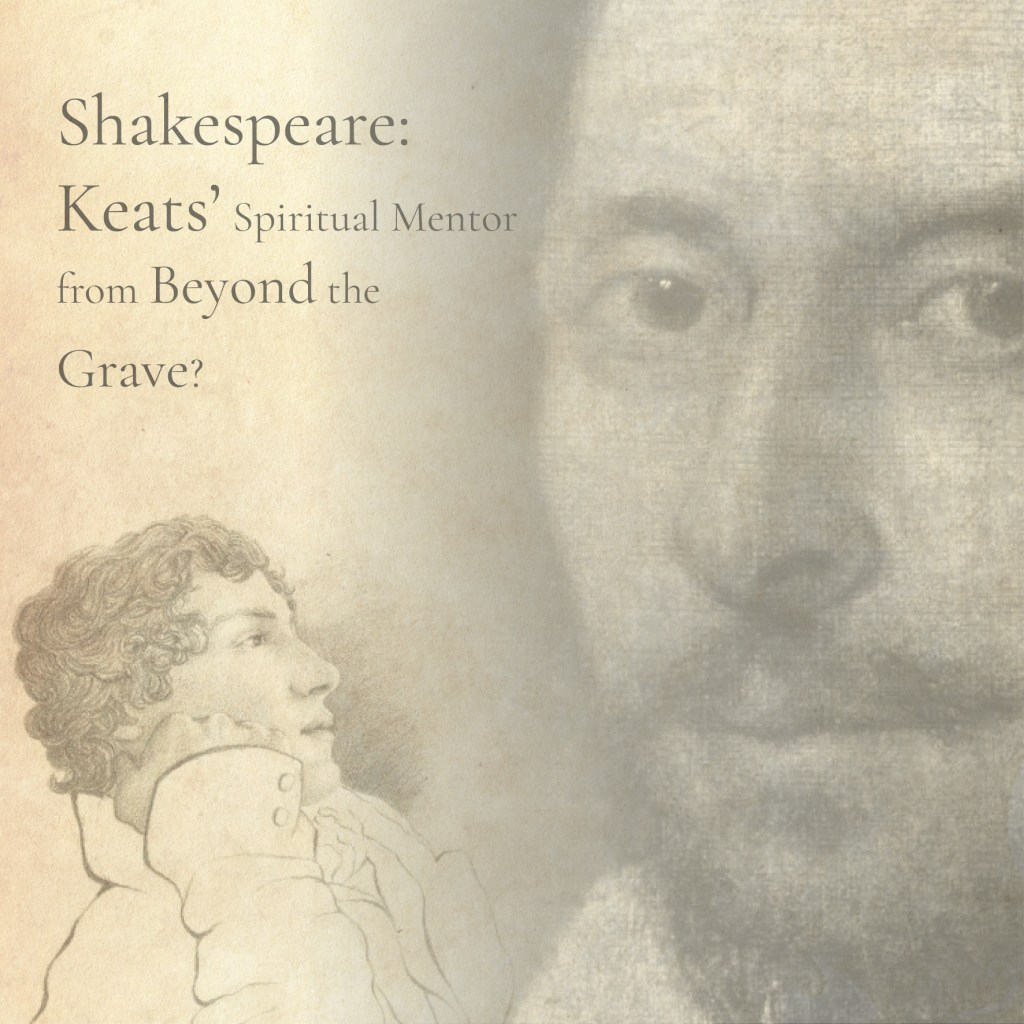
If Keats could be said to have had a spiritual guide it was Shakespeare (notwithstanding his high esteem for Jesus and Socrates). Shakespeare was not merely an influence on Keats via the works he left behind; he was a felt presence in Keats’ life. In one letter to the painter Haydon, Keats writes:
I remember you saying that you had notions of a good Genius presiding over you—I have of late had the same thought. For things which I do half at Random are afterwards confirmed by my judgment in a dozen features of Propriety—Is it too daring to Fancy Shakespeare this Presider? When in the Isle of Wight I met with a [bust of] Shakespeare in the Passage of the House at which I lodged—it comes nearer to my idea of him than any I have seen—I was but there a Week yet the old Woman made me take it with me though I went off in a hurry—Do you not think this is ominous of good?[5]
I would answer, ‘Yes,’ and that the astute kindness of that old woman is worthy of note. Within my own Sufi tradition, it is not uncommon for a mystic to receive guidance from a teacher beyond the grave. Some may object that Keats was suffering from wishful-thinking and an over-active imagination. There’s certainly a danger that our deluded egos can begin to see self-aggrandising signs in every common occurrence. Yet I think Keats had enough purity of heart and grounded common sense to reliably discern.
For Keats, Shakespeare exemplified poetic genius and the self-effacement inherent in what he termed ‘negative capability’. In a letter to his younger brothers George and Tom, he describes this capacity as follows:
… at once it struck me, what quality went to form a Man of Achievement especially in Literature & which Shakespeare possessed so enormously—I mean Negative Capability, when man is capable of being in uncertainties, Mysteries, doubts, without any irritable reaching after fact & reason.[6]
In a talk from Keats House in 2016, Elizabeth A. Hin insists that this ‘negative’ state is of profound importance to humanity right now. Her talk, entitled ‘Spiritual Threads and the Weaving of Beauty ~ Sentiments Regarding John Keats and Poetry’, is available to stream online.[7] Beth is founder of the White Rose Foundation, which exists to ‘promote understanding of the shared holiness and the intrinsic harmony of all of the world’s religions’, and she describes herself as having been ‘mentored by many renowned traditional tribal Elders of several continents’.[8] Beth speaks to the heart rather than the head, and as I listened that evening it seemed to me that she wasn’t just speaking to the small group of us physically present, but also to an unseen audience. She relates of Keats:
He went through both an easy and difficult childhood. And he tended his [younger] brother dying of tuberculosis, which made him seek an answer of something beautiful, because of the negative space which existed in his life when his brother died.
Okay, so this concept became a new form of the Western world’s idea of thinking in terms of beauty and seeking. Before Keats arrived in his mature work, a great deal of the Western personality—this would be the Greco-Roman Empire, the Mesopotamian, northern Africa—became a statement: ‘I am here.’ ‘I have power.’ ‘This is the poet of my country.’ We could have Homer, who was allowed to speak poetry because he was blind. So in a war we would not kill Homer, we would allow him to live. But he would speak of great warriors and great women and sirens and oceans and these extraordinary words of poetry that filled the space. They would fill the space. So a great deal of our language of the world now is what space does one fill? What power does one hold? ‘Who are you?’ ‘Who am I?’ ‘Who wins?’ ‘Whose poetry is greater?’ ‘What form is more substantial?’ ‘Which language is superior?’ ‘Which way of wearing our hair?’ ‘How should we eat?’
But what happened to Keats is, when his brother died, he realized that there was an empty space, a negative capacity. And he realized, I am asking a question about that. And interestingly, he found that it was answered. And when it was answered, he would write a poem. And then he would ask again, and it would be answered. And he would construct a poem.
If we pair this self-effacing ability to inhabit negative space with the death-wish that occurs in a number of Keats’ poems, we may perceive that taken together they’re an expression of a desire for ego-death. True enlightenment requires that the self-centred ego be toppled from the throne of the heart, a throne it has usurped from Spirit. A heart ruled by egoism and cut off from Spirit is closed, hard, diseased—dead even. For the heart to become truly alive it must begin to shake off the ego’s compulsions, opinions, and self-absorption. When the heart rebels against the ego in this way, the ego experiences it as a kind of death or dissolution. This is the soul-work symbolized by the seven alchemical stages: calcination, dissolution, separation, conjunction, fermentation, distillation, and coagulation. In Sufi Islam, the same process is mirrored by the seven ascending levels of the self drawn from the Qur’an: the compulsive self (nafs al-ammarah); the repentant self (nafs al-lawwamah); the inspired self (nafs al-mulhamah); the tranquil self (nafs al-mutma’innah); the fulfilled self (nafs al-radiyyah); the surrendered self (nafs al-mardiyyah); the purified self (nafs al-zakkiyah).[9] Each stage involves some kind of death; thus the imperative ‘Die before you die’ that Sufis attribute to Muhammad, and the Qur’an’s insistence: ‘Every self (nafs) shall taste death.’[10] The aim is an empty, selfless state evoked so beautifully by Keats’ urn (in ‘Ode on a Grecian Urn’)—itself a variation on the alchemical crucible or holy grail (more on this in Chapter 7). This is a state that troubles the ego—but delights the soul.
Daniel Thomas Dyer is an author, musician, publisher, and regular blogger at Rumi’s Circle. He is a dervish in the Mevlevi Order founded on the wisdom of Mevlana Jaluluddin Rumi, under the guidance of Shaikh Kabir and Camille Helminski. His first book was The 99 Names of God, a family guide for all ages. God willing, his next book will be The Mystic Keats, exploring Keats in the light of Rumi and Sufism.
Follow him here @dantomdyer
[1] Masnavi V: Introduction, ‘The Law, the Path, the Truth’, The Rumi Daybook, trans. Kabir and Camille Helminski, Shambhala, p. 285.
[2] ‘Paths of the Ancient Sages’, Peter Kingsley, Crossing Religious Frontiers, ed. H. Oldmeadow, Bloomington, p. 66. See here: https://peterkingsley.org/wp-content/uploads/Paths-Of-The-Ancient-Sages.pdf
[3] Fama Fraternatis. See here: https://order.rosy-cross.org/sites/default/files/docs/Waite%2C%20A%20E%20-%20Fama%20Fraternitatis.pdf
[4] ‘Remarks on Ramon Lull’s Relation to Islam’, Róbert Simon, Acta Orientalia Academiae Scientiarum Hungaricae, Vol. 51, No. 1/2 (1998), p. 24.
[5] Letter to B. R. Haydon, 11 May, 1817.
[6] Letter to George and Tom Keats, 27 December, 1817.
[7] https://soundcloud.com/elizabeth-anne-hin/spiritual-threads-and-the
[8] https://www.thewhiterose.org
[9] Ammarah is taken from Qur’an 12:53; lawwamah from 75:2; mulhamah from 91:8; mutma’innah, radiyyah, and mardiyyah from 89:27–28; and zakiyyah from 87:14.
[10] Qur’an 3:185.
 Rumi's Circle
Very beautiful and inspiring explorati
Thank you, Mariana!